

#1 Product
sidejobs.ma — a platform for side jobs accessible from Morocco
Product type: early-stage & pre-revenue platform with real users and early traction (subscribers, surveys, and feedback calls)
The #1 platform for side jobs in Morocco. It started as a newsletter in October 2024, where Moroccan professionals receive a weekly email with the latest side job opportunities that are accessible from Morocco.
Today, we’re in the early stages of becoming a membership-based platform with a set of services and offers related to side job hunting.

👩💻 Product Management Case Study
1. Context
While exploring side income opportunities myself throughout different years and life stages (university student, full-time employee, and full-time freelancer), I was repeatedly facing the same issues:
- Online research generally leads either to job boards or popular freelance marketplaces (Fiverr, Upwork, etc.) where opportunities are mixed and you need to find yourself the ones that are actually side jobs/gigs
- I need to find the ones that are accessible for me as a Moroccan & Morocco-based (plenty of side jobs are “US only”, “UK only”, etc.)
- I also need to be aware of scams & fake opportunities, as there are a lot of them nowadays on many job boards and platforms…
And then, I can finally filter the ones that I can actually apply for based on skills, requirements, etc.
The process is time-consuming and more complicated than it should be because there is no single platform created specifically for side jobs, even globally, let alone locally.
Over time, I:
- Wished I could just find these opportunities already researched, filtered, and organized in one place instead of having to research and filter across multiple platforms, communities, and job boards.
- Learned so many unpopular places to find side jobs that you only knew about as you gain experience...
- Noticed how often others asked the same questions on social media and online communities I joined. I personally found many opportunities that I’m not personally interested in, but I wish other people knew about…
This recurring friction + the experience I gained + the demand I noticed led to building sidejobs.ma - a place where Moroccans (and basically anyone else) can go to and know about the latest side jobs easily...
2. Problem statement
People looking for side income opportunities need to put in significant time and effort to search and filter across multiple platforms. For some nationalities and locations, they need to spend even more time and effort, as many opportunities are inaccessible to them.
The current way for side job hunting has 3 core unmet needs:
- Discovery: People don't know where to find side jobs beyond the most popular freelance platforms and job boards
- Filtering: People need to put significant manual effort into finding side jobs that match their location, availability, skills, and experience
- Trust: People need to be careful of scams and fake opportunities during their research
The existing solutions fail to provide a centralized, trustworthy source adapted to side job seekers, where side jobs are curated and delivered regularly. Let alone guidance and helpful resources to increase their chances in a very competitive global market.
3. User research
While such a platform can serve several types of users, there are 3 primary segments of users:
- Professionals & students who want to earn side income alongside their full-time jobs/studies
- Stay-at-home parents who want to have a flexible source of income on the side
- People who are seeking a more flexible lifestyle instead of a traditional full-time job
There is also the other potential side of users which is the companies and businesses that hire people for part-time jobs, fractional work, side gigs, etc.
At this initial stage, I chose to focus on the local market (Morocco) and specifically on segment 1. This is because it’s the most visible segment spotted through my observation of online communities; this makes it the most accessible segment to identify, research, and interview.
I combined an online survey with conversations and observations from Moroccan online communities (Facebook groups, Reddit, etc.) where people discuss related topics such as freelancing, remote work, and additional income opportunities.
The goal was not only to validate the existence of the problem, but also to understand what this segment expects and needs from a solution.
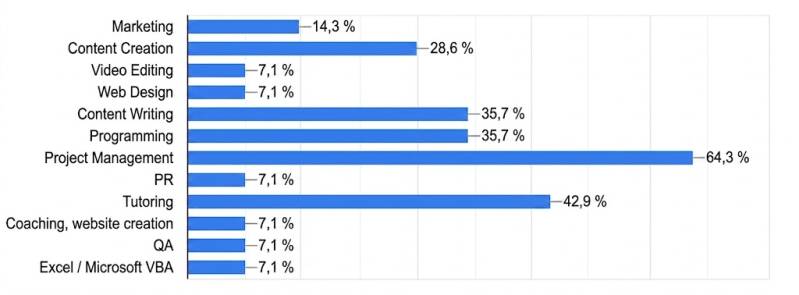
The survey was posted in a small Discord group of people who attended a paid course about side hustling for full-time Moroccan employees. Here are the key results that will be used to shape the product:
- 64,3% prefer to do their side job hunting on weekends (they voted for Saturday as the best day for them), while 35,7% preferred Monday)
- They are willing to dedicate 10 to 30 hours to a side job (with 57,1% willing to dedicate only 10 hours)
- Both Morocco-based and people living outside of Morocco are interested in finding side jobs
- They have acquired some skills through their current studies/work and want to use them to generate side income
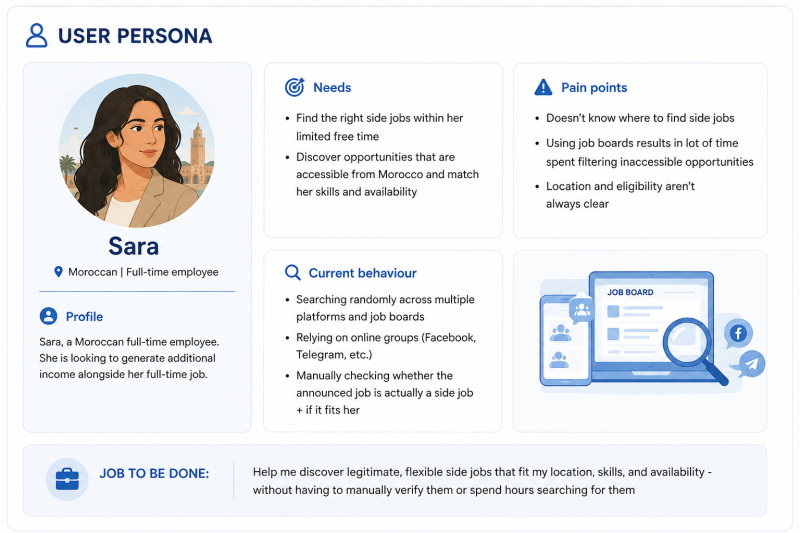
User persona
4. MVP & Product decisions
The initial version was launched in late 2024 with a simple landing page to capture leads and test interest.
Then, the current version was built and beta-launched in late 2025: sidejobs.ma
Constraints:
As a solo project, the MVP had to be built within a limited set of resources. These constraints directly shaped the scope of the MVP:
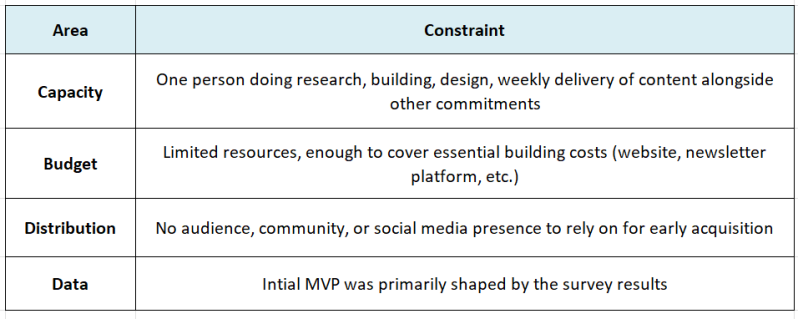
MVP intent: reduce the time and effort needed for side job research through the delivery of curated opportunities that are already filtered for relevance and accessibility.
Key assumptions:
- Users value curation more than volume
- Users prefer opportunities delivered to them rather than actively searching
- Users prefer side job opportunities that are remote, flexible, and require a few hours per week
Product decisions:
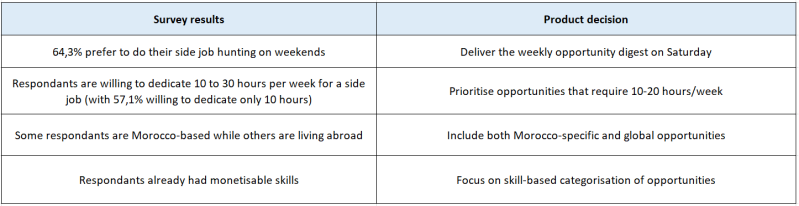
Core components:
- Manual research and filtering of side job opportunities (to ensure quality at this stage)
- Regular delivery of opportunities once a week, specifically on Saturday
- Email as the primary delivery channel (for more convenience)
- Categorization of opportunities based on location (Morocco vs. global opportunities) and skills (social media & marketing, content, design, web development, project management, etc.)
- Display of the opportunities' details (hours needed, pay, etc.) to make it easier for users to scan opportunities
Tools used: MailerLite, HTML & CSS, and APIs
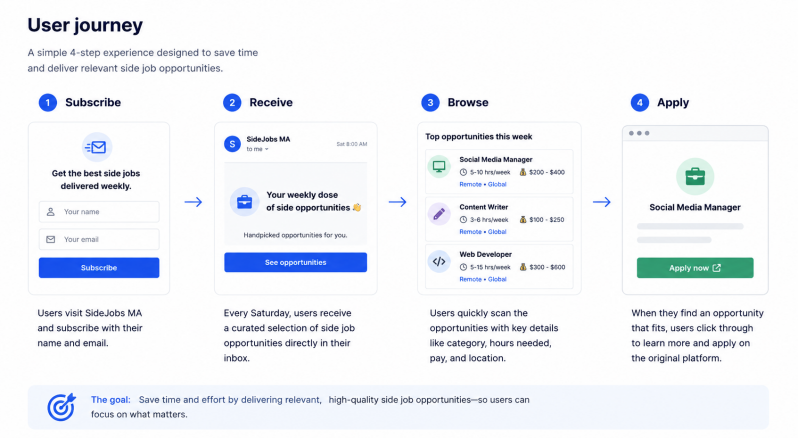
User journey:
The user journey was intentionally minimal to reduce friction: users only needed to subscribe once with their name and email. From there, curated opportunities were delivered directly to their inbox every Saturday, where they could quickly scan the opportunities, select the ones relevant to them, and apply through the original source.
What I intentionally did NOT build & include (for now)
- A job board or marketplace (to reduce building costs and avoid complexity and maintenance overhead)
- User accounts, dashboards, etc. (to make it easier for users to try the product)
- Automation of the research and filtering process to prioritize accuracy & quality over volume & scale
5. Results & Next steps
Although the product is still in an early stage, several signals indicate real demand:
📈 Acquisition
- Growing subscriber base achieved through only a few posts in closed communities (no paid ads or social media presence)
🔄 Retention
- Churn rate is 0% from October 2024 to April 2026 (with only 3 recent unsubscribers to date)
💌 Engagement
- Average open rate is around 60% and average CTOR is around 50% (2026 numbers)
- Engagement through replies and community discussions
🗣️ Qualitative signals
- Feedback calls with users confirmed the value of the product as well as an interest in turning the newsletter into a structured platform with additional services
- The product was also featured on The Way Up's Hot Seat live where it received direct positive feedback from the target audience
Key risks
- Scalability of manual curation
- Long-term monetization strategy (the right business model to maintain the platform)
- Maintaining quality as volume grows and automation is on the table
Next hypotheses to test
Can the platform acquire users sustainably?
→ Experiment with social media and content as acquisition channels
Will users pay for additional value?
→ Experiment with a paid tier (premium curation, early access, or additional side-job-related services)
Can curation scale without compromising quality?
→ Explore which parts of the current workflow can be automated with no impact on quality